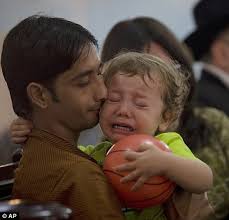
Moshe still thinks of Mumbai as home. The little boy believes his parents live there, and often asks about them. His little world
Moshe revolves around school and play, drawing and colouring, climbing and falling. Terror and bullets don't mean anything to him. Not yet.
Moshe's life appears like that of any normal three-year-old—comfortable, secure and engulfed by love. But behind the surface lies a horrific tragedy that could haunt him as he grows older.
Moshe lost both his parents in the Mumbai attacks last year, as terrorists laid siege to the Chabad-Lubavitch Jewish Centre in a determined attempt to target the community. He had stood crying near his parents' fallen bodies, as terrorists stalked up and down, killing four other Jews in the building.
That Moshe is alive is a miracle, largely engineered by his devoted Indian nanny, Sandra Samuel, who ran to him when she heard his cries, scooped him up and hid in the kitchen until the nightmare was over. For hours they sat wedged between the fridge and the wall. Sandra's bravery became the stuff of legend in the Jewish community from New York to Canberra, sparking a steady stream of fan mail and eulogies. She was given special permission from the Israeli government to accompany Moshe here as the country mourned its dead and adjusted to the idea that its citizens were marked even in India where historically Jews have been welcomed rather than persecuted.
Sandra still takes care of Moshe at his maternal grandparents' home in Afula in northern Israel, a small town near Nazareth. She is Moshe's Indian connection, a real-life link to his parents Gavriel and Rivka Holtzberg, who ran the centre in Mumbai as representatives of the orthodox Chabad movement which seeks to bring alienated and secular Jews back to the fold. Sandra, a recent widow, had grown attached to the family over time, often referring to the couple as 'my rabbi' and 'my Rivka'. Just as the couple had treated their Indian nanny as a family member, she looked after their son as her own, risking her life to save him.
For the Israelis and the larger Jewish community, Moshe and Mumbai will always be synonymous, just as Moshe and Sandra will be for Indians. Mumbaikars want to mark his progress, learn about his favourite food, his playground tricks, his best friends. They feel a responsibility, a connection with the little Jewish boy who was orphaned in the city's collective nightmare. But Moshe's grandparents, who are fiercely protective, adamantly refused permission to Indian journalists to meet either Moshe or Sandra. "It's not good for Moshe. You can't make him crazy," Yehudit Rosenberg, Moshe's grandmother and a former teacher, said sternly over the phone.
A woman of few and firm words, Yehudit described Moshe as a very, very happy boy who did what any child his age would do. "He can be bratty and he can be sweet. He is not too quiet and has connected well to his many cousins." If Moshe is off limits, could one meet Sandra? "No, no. Not now. Very, very busy. Call at 4 pm." And so it went for a week. Yehudit stalled, evaded and insisted that Sandra was very, very pleased to be in Jerusalem and would stay as long as Moshe needed her.
However, Sandra told a local TV channel this week that it was time for her to return home.”My home is India. I belong to India. The kid is quite attached to his grandparents now and I would like to move on," she said. The family keeps her under wraps and allows only well-calculated media appearances aimed at satisfying local curiosity and interest. "I felt a kind of responsibility when Moshe lost his parents, knowing that he was so attached to me. Now he has adjusted to the new surroundings and his family members just adore him," she said on Israeli television. It must have been a long year for Sandra who was transported from a throbbing, cosmopolitan Mumbai and planted in a quiet, religious Israeli town dominated by orthodox Jews.
In a profound irony of life, according to the Hebrew calendar Moshe's third birthday and the first anniversary of his parents' brutal murder fell within a day of each other. He turned three on November 18, on which at sundown began the observance of the death anniversary. Celebrations and mourning came arm in arm for the family. "Sadness has come with happiness," said Yehudit.
A third birthday for an orthodox Jewish boy is very important—he gets his first haircut and begins his formal Jewish education. The family was crazily busy with all the preparations, the birthday party, the various prayers, the memorial dinner for a thousand people. Moshe made an appearance on Wednesday night along with Sandra at a public dinner organised by Chabad near Tel Aviv, looking puzzled at the myriad camera flashes.
The grandparents are trying to find a good balance for Moshe, according to Rabbi Joshua Runyan, a Chabad spokesman and news editor of the Chabad.org website. Leaders of the Chabad movement, who just ended their annual conference in New York, have prepared a Torah scroll handwritten by Jews from around the world to send back to Mumbai after the centre is rebuilt.
The martyrdom of Moshe's parents has rallied worldwide support for the movement. The group's website invites followers to do a mitzvahb or good deed to honour the memory, and thousands of Jews from different countries have made pledges, including a woman who decided to have more babies, while another promised to call lonely souls. More than 200 Jewish babies have already been named after Moshe's parents, according to Runyan. Moshe may live in Afula, protected from the public gaze, but he will always have a large family.
Thursday, November 19, 2009
Moshe's little heart still beats for India


Sunday, November 15, 2009
Obama's Chinese odyssey
Tarun Vijay
The night before President Obama's first Asian tour began, he was trying to comfort an America deeply in shock after Maj Nidal Malik Hasan killed 13 American soldiers who were bound for Afghanistan. Yet, Obama's nine-day tour, which took him to Tokyo, Singapore, Shanghai, Beijing and Seoul, was marked more by economics than a consolidation of the Asian powers against terrorism. That's how he is trying to assure Americans — bringing back buoyancy to the US markets, reducing unemployment and making Asians buy more American goods rather overfilling American bazaars with Asian goods.
Hence, more than any other country China became the most significant stopover, and longest too — three nights and three days beginning Sunday evening, November 15. To make the Chinese receptive he refused a meeting with the Dalai Lama in Washington, and remained noncommittal whether he would raise issues of Tibet and human rights violations with his Chinese counterpart. Though an overcautious China provided all the reasons to Obama for a Tibet remark when its foreign ministry spokesperson raised the issue via Abraham Lincoln , referring to Obama — he is black, he admires Abraham Lincoln, so he, of all people, should sympathize with Beijing's effort to prevent Tibet from seceding and sliding back into what it was before its liberation by Chinese troops: a feudalistic, slaveholding society headed by the Dalai Lama.
But Obama may not necessarily oblige Dalai supporters as he wants to project a different image of America — a suave , conciliatory nation that can be talked to. His message to China from Tokyo was warm and friendly, wanting to build strong ties and not taking the rise of China as a threat. And he introduced himself as a pacific president with such personal history that the audience in the Suntory hall of Tokyo gave him a standing ovation. He said: “I am an American president who was born in Hawaii and lived in Indonesia as a boy. My sister Maya was born in Jakarta and later married a Chinese-Canadian. My mother spent nearly a decade working in the villages of Southeast Asia, helping women buy a sewing machine or an education that might give them a foothold in the world economy.” “So,” he added, “the Pacific rim has helped shape my view of the world.”
America needs a supportive Chinese market and wants China to move towards a market-based value for its currency. So Obama's meeting with President Hu Jintao and Premier Wen Jiabao would concentrate more on economic issues and yes, AfPak policy, which affects the regional power balance but won't touch any controversial issues. As New York Times put it, he is clearly seeking to avoid alienating Beijing on the eve of his inaugural visit to China.
That's a big morale booster to China specially it is engaged in a wordy duel with India on border issues that reached a ‘cold war' level during the Dalai lama's Arunachal visit. Hence a natural corollary to Obama's China visit would be how it will affect India-China ties. Observers say the recent Chinese ‘war of words' with India and Chinese government-run media's xenophobic reactions and commentaries against Indian positions — reminding us not to forget 1962, can also be attributed to the growing India-US closeness symbolized in the Bush era's nuke deal. That has made China feel threatened by an India-US alignment. Hence the pressure on India has been building up. Another factor is the increasing US influence in Asia, which China has never liked. China thinks that India, which had kept a genuine non-aligned relationship with Washington has now completely gone into the US camp after the nuke deal. Indira Gandhi's regime and Vajpayee's strong nationalist stand post-Pokaran 2 showed India independent.
No more now, is the Chinese perception. This has put India under a bigger strategic burden and complexity. We are not sure if the US will help us during a skirmish with our northern neighbour, as US-China ties would be more important to Washington than help to Delhi. Obama's Asian tour doesn't seem to have taken India as an Asian power, and Obama would meet Indian Prime Minister and the President at Washington, and not in Delhi. Just before Obama left for China, the US administration refused to allow Indian intelligence officers to interrogate American national David Coleman Headley, arrested by the FBI on charges of plotting a major terror attack in India at the behest of Pakistan-based LeT, though India had given the FBI permission to interrogate Kasab in Mumbai. The US will also put pressure on Indian leaders to sign the CTBT and accept the US position on carbon emissions. It has also not changed its ‘black list' that bans trade in sensitive technology for some Indian companies, including a dozen key government entities like the Indian Space Research Organization. Though the US continues such trade with countries like North Korea, Pakistan and China that have a record of proliferation.
So a warmer confidence-building between the US and China may not necessarily mean an easing of the pressures on India. We will have to fight our battle on our shoulders alone.
That apart, a better US-China relationship would certainly be a development having its soothing effect on the region, as South Asia has increasingly seen geopolitical tensions rising on account of a bitter US-China rivalry and their efforts to curb each other's influence. Pakistan, which receives charitable grants and military help from, amazingly, both the rival countries, is in a state of a multi-control towers with non-state players as much powerful as the state authority dependent on US doles. A closer US-China relationship is not seen changing the status quo. China is a hard bargainer and long back it began building up its case against what it terms ‘unfair' policies of the US. Its state-controlled newspapers published public opinion polls showing public anger against Washington on economic matters. One of them said: “The unprecedented and increased trade protectionism measures the US has launched against China recently have triggered a strong fury of protest among the Chinese public. A recent survey conducted by huanqiu.com shows that more than 90 percent of web users believe the US is seriously ruining the principle of freedom of international trade.”
Ultimately it's the Chinese strength and military power coupled with its strong economy that has seen world leaders recognize its might and seek its cooperation rather than get into conflict with it. Obama's visit also underlines the same truth of diplomacy. As one American analyst succinctly tried to put the matrix of the US China relations, ‘the most important division will be between centers of order and centers or sources of disorder, it is vital to American interests that China remain a center of order. America needs to handle a rising China the way Britain handled a rising America, not a rising Germany.'
Saturday, November 14, 2009
The liberal Hindu is on a global high
Tarun Vijay
A week ago i received an offer that was difficult to refuse. I was invited to speak to a distinguished audience at Taj Mumbai, which was partly destroyed during the 26/11 terrorist attacks. Nearly a year later, the hotel stands restored. In a way, it may be seen to represent the spirit of Hindu resurrection.
Its rise, literally from the ashes, could be seen in the context of the ancient Somnath temple, which was repeatedly destroyed by invaders and rebuilt each time. The audience was the great surprise of the evening. It was well-heeled and very keen to find out about the global Hindu footprint in the contemporary world. That’s the ‘new Hindu’ — modern, rich, powerful and a staunch believer in pluralism and diversity.
This ‘new Hindu’ is everywhere today. Lakshmi Mittal, one of the world’s richest people, now lives in London. Molecular biologist Venkat Ramakrishnan, who shared this year’s Nobel prize for chemistry with his colleagues, is based in the US. Pranav Mistry, who works at MIT’s tech lab, is the founder of the futuristic techno invention SixthSense which may change the way we live. Indra Nooyi, PepsiCo chief and ranked by Forbes magazine as one of the world’s 100 most powerful women lives in the US. The list is endless. All of them are players at the global level; they make waves in their respective fields and force the world to sit up and take notice. They are a force to reckon with; they are difficult to ignore.
Till a few centuries ago, the Hindus were confronted by marauding Muslim invaders and proselytizing Christian missionaries. But they showed extraordinary resilience. Their rise to great heights is this millennium’s incredible saga of resurrection.
These ‘new Hindus’ are taking the religion to new lands, which would have been unthinkable just a little while ago. This is why Shanghai celebrated its first Diwali with businessman Vijay Chaudhry from Jhunjhunu in Rajasthan. Swaminarayan temples world wide are turning into Hindu awareness centres including the one at Muscat. Sri Sri Ravishankar was asked to spread the message of peace in war-torn Iraq.
Some little time ago, Time magazine’s cover story was on the healing powers of yoga and chanting of ‘Om’. This is the first year that Diwali was celebrated in that seat of world power, the White House. The Gayatri mantra can now be heard in Rome, New York and Beijing. All this thanks to the liberal and successful Hindu, who will never bomb his adopted country, but instead makes it home by importing a bit of his native land. In Paramaribo, Suriname’s capital, the local river became the Ganga for Indians settled there; in Mauritius’ Port Louis, a water body was named Ganga Talab; in Bangladesh, Hindus have strengthened a movement to rebuild a Kali temple destroyed in 1971.
The point to note is that today’s Hindu is different from before. He is more empowered, open to new ideas and adventures. His political affiliations may vary but he believes that India needs a revival with an unmistakable Hindu stamp. Spiritual gurus such as Sri Sri Ravishankar and Mata Amritanandamayee are among some of India’s most globally admired Hindus. Unlike the fossils of Deoband and Raj Thackeray, they strive for the greater common good, which empowers India to be strong as well as punish the wicked.
The Rashtriya Swayamsevak Sangh (RSS) has become India’s largest non-governmental effort in hospitals, blood banks, eye donation, schools and the barefoot doctors’ movement. This, at a time that it is threatened by a class of attacker known as ‘the secular’.
Hinduism is the world’s only living religion to be known for its compassion and wisdom, rather than its massacres. The challenge is to build a grand future that does not knock the sentiments and beliefs of the majority, which has been trying to rise after centuries of
brutalization.
The writer has just published India Battles to Win and is director of the Dr Syama Prasad Mookerjee Research Foundation
Thursday, November 5, 2009
Medieval trap
Tarun Vijay
When the nation is facing grave threats from the Maoists and the Lashkar-e-Taiba's Islamist mad-heads, and discussing how to counter the Chinese arrogance, suddenly mullahs living in a frozen Arabian time zone have cried that they won't sing "Vande Mataram".
Are they concerned about the people? People whose lives they think they govern through some fatwas and scriptural instructions? Do they realize that hardly any educated Muslim with his head firmly positioned where it should be, listens to them leave aside "obeying" their dictates? Still they make some noises to get media attention and register their political presence.
What was the compulsive necessity for making such an announcement while the home minister was there to have a plateful of appeasement biryani in hope of garnering their votes for a 21st-century government?
One explanation that has come to us through Deoband observers is frighteningly pregnant with serious consequences to our already strained social fabric. The Congress wants to create another monster out of Muslim fanatics to further erode Mayawati's vote bank and simultaneously distract public attention from its failure on the Maoist front and keep the public debate away from the price rise. These are the issues it couldn't handle; hence, the distraction was immediately needed. And the way fanatics helped the British before India was vivisected, the maulvis have obliged the party in power. It's advisable not to get trapped in this political lunacy, but then the media will be taking it up in a big way for certain unexplained reasons and there will be obvious reactions and diatribes from both sides to keep the issue alive.
Public memory shouldn't be too thin. Remember how Bhindranwale was created, the statements about his "saintliness", the permission to his brigands to roam free through Delhi's roads brandishing AK-47s on top of buses. And then only too recently, Raj Thackeray was propped up to counter Shiv Sena-BJP's growth in the Maratha land.
They forget that a Bhindranwale and a Raj results in self-defeat, a defeat for the national unity and collective goals of economic prosperity. The Deoband mullahs have never helped their community in making economic, social and educational progress. At any moment of a social crisis among Muslims, they have delayed any decision or taken a retrograde stand. The "shining" examples of their fossilized mentality were too visible during the Shah Bano case, Gudiya's tragic story and equal right to Muslim women. They kept a studied silence when five lakh Hindus were driven out of their homes in the Kashmir valley, after announcements were blared out on the dreadful night of January 11,1989, asking Pandits to get out and leave behind their women. Jammu & Kashmir is the only Muslim-majority state in India and if Deoband is "concerned" about Islam's peaceful, and humanitarian face, why should it not try to influence the terror groups operating in the name of their religion and in turn, as the maulvis say, bringing bad name to their great message of universal brotherhood?
But never will one find them engaging the "bad elements" and issuing a fatwa against their "anti-Islamic" action. All they would do is to irritate Hindus and punch the patriotic people belonging to all denominations with untimely and out of context pronouncements like the one they made while the "man with a mission" Chidambaram was in their midst.
They know very well that "Vande Mataram" is a song celestial for a patriotic Indian no matter to which stream of faith he belongs. It's a song that inspired Bhagat Singh and Ashfakullah alike and is more popular with an electrifying affect than any other song. An A R Rahman refashioned it and offered a beautiful rendering of it with Bharat Bala making its universal appeal more thrilling. Millions of Indians, Muslims, Hindus, Christians and all denominations sing it with pride and confidence. It was the song which united India against the British repression that had caused the death of millions in Bengal creating an unnatural famine .The original song appears in the famous novel of Bankim Chandra Chattopadhyay named "Anand Math" which describes a revolution against the foreign yoke led by ochre-robed monks. The deity is Mother India, the song is in praise of the Mother and it's accepted as a national song by the Constitution. No organization can be given an option to denounce or reject the icons representing the national ethos and the spirit of the freedom struggle. If they don't belong to us, they don't have a right to enjoy the fruits of a pluralist society, democracy and a Constitution that gives them more than their ilk offers to any non-Muslim anywhere. Instead of making an Indian identity stronger and helping their community to join the national mainstream endeavouring for a happy and progressive life, they are, at a time when an average Indian is more concerned about dal roti and security, more concerned about a song that was opposed in the same manner by Pakistan seekers pre-1947.
Then to which country these Deobandis and Jamiat's big-mouths belong? What's their problem?
It's not the song they are opposing. The message is loud and clear that they don't want to forge a sense of unity with the national life. They want to create a divide on the lines of a Muslim Indian and an Indian Muslim for political leverage. P Chidambaram is certainly not a scholar of Islamic theology that they invited him for a religious discourse. The home minister was there on a political mission. The home minister of India must have made them sing an Indian song rather than emboldening them to oppose it.
Their Arabian-night fever must be brought to an end with the firmness of a united Indian patriotism symbolized in our Constitution and the ever victorious tricolor.
Tuesday, November 3, 2009
The bigger anguish is that Hindus don’t unite ! - H.H. Dr. Jayant Athavale
The Following interview of Sanatan Sanstha's founder H. H. Dr. Jayant Athavale was taken by 'Daily Saamana' regarding the issue of Margao, Goa Blast and alleged involvement of Sanatan in it by Congress Government and Goa Police !
Sanatan Sanstha has been targeted by the Congress government in Goa after the bomb blast incident in Goa. Efforts were made even in the past to implicate Hindu organisations in many cases. However, the police fell flat on their face, as they could not find solid evidence in any of the cases. Even after that, their activities to target Hindu organisations at the instruction of the government, are still going on. Here is a forthright interview from Sanatan Sanstha’s founder Dr. Jayant Athavale on why this is happening, what is the fact in the Margao case, and whether Sanatan is involved in it.
Question : What activities (karya) does ‘Sanatan Sanstha’ undertake?
Answer : ‘Sanatan Sanstha’ is an organisation working in the spiritual field. Like other spiritual organisations Sanstha does spiritual activities like organising satsangs, balsanskar varg and also social activities like health camps, offering clothes to needy students, etc.
Question : Pro-Hindu organisations are being drawn into the Thane, New Mumbai, Pavel, Malegaon and now Goa bomb blasts. Why is the government doing this without solid evidence?
Answer : The effort is on to show that terrorism is not only brought about by the minorities (of India), but also by the majority (Hindus). Has the government, which is calling the Hindu organisations ‘terrorists’, ever conducted transparent investigations in cases like the Bofors weapons’ scandal, massacre of Sikhs in Delhi, where the government itself was the accused ?
The root of all problems in the nation is ‘vote bank politics’. ‘Perform anti-Hindu acts and earn the votes of the minorities’ seems to be the stance taken in this sort of politics. Of course, all the politicians involved in this variety of politics are acting under different garbs like that of communism, socialism, secularism. They will obviously behave like this. I am not surprised that the snake is spitting venom. However, I am surprised that, pro-Hindu people are not uniting on the issue of Hinduism, when there are so many attacks on Hinduism today.
Question : Do you feel that it is a crime to live as a Hindu in Hindusthan (‘The land of Hindus’ – India)?
Answer : Secularism has become a curse for Hindus. On the very day of Diwali, the highest Dharma Guru of Hindus, Jagadguru Shree Shankaracharya Swami Jayendra Saraswati of Kanchi Kamakoti Peeth was arrested, but no government has the courage to explain the language of law to the Imam Bukhari, who talks about war against the nation.
In Hindusthan, democracy exists for everyone else, but for Hindus living as Hindus, the treatment that has to be endured by them is that of the ruthless Mughal (Muslim invaders who raped and pillaged India) regime. Open denigration of Hindu Deities, riots instigated by purposely inciting Hindus during their festival celebrations and on top of that, the protection provided by the Congress (India’s ruling party) government to all those who do this, are examples that it has become a crime to live in Hindusthan as a Hindu.
Question : Why is it that the government pampers Kasab, who attacked our nation (through the Nov 2008 Mumbai terrorist attack), but targets those working peacefully for nation building?
Answer : The answer to this question is, by pampering Kasab the math of vote bank becomes stronger. In the current situation, to do the work of nation building, first the terrorism unleashed by the minorities needs to be overcome. All the organisations have now realised the truth in this.
However, the communists and secularists are afraid that this increasing awareness among the nation-lovers will badly affect the collective votes from the minorities. Therefore, now the path of labeling the nation-loving organisations as terrorist outfits and then shutting their voice by banning them, is being followed.
Question : The Police have not yet given any report in the Goa blast. Then how is it that Sanatan’s name came up suddenly ?
Answer : Within one hour of the Margao blast there were flashing news reports of Sanatan Sanstha being behind this blast. The investigating agencies in Goa have tried to pin the blame on Sanatan, by jumping to the conclusion that, since Malgonda who died in the blast was a Sanatan seeker, he was surely behind the blast. But at least collect initial evidence proving that Malgonda has done this blast before arriving at this conclusion ! The rulers, investigating agencies and media are working with the attitude that whatever they say is right.
Question : The home minister of Goa, Ravi Naik is at the forefront in defaming Sanatan. Is there any politics behind this ?
Answer : Yes, of course ! The investigating team confiscated the documents of Sanatan’s transactions of the last 10 years. What is the relationship between the blast and Sanatan’s transactions of the last 10 years ? Secondly the police confiscated Sanatan’s books. Do Sanatan’s books teach how to produce bomb blasts ? In addition, they are also checking if we have the permissions for the construction of the ashram building. How are these permissions related to the blast ? When Sanatan is being trapped from all sides, only a few organisations like the Shiv Sena and the Sriram Sena have rushed to help. It is definitely sad that anti-Hindus blatantly carry out anti-Hindu activities, but it is sadder still that Hindus fail to unite.
Question : The police fell flat on their face without evidence in the Malegaon blast case ! Will the same happen this time too ?
Answer : Yes, exactly the same thing will happen ! Sanatan’s innocence will be proved in this case, but the question is not only about proving the innocence of Sanatan. The unnecessary mudslinging on Sanatan has caused irreparable loss to our mission ! Who will compensate for this loss?
Question : There is talk about a ban on Sanatan. The socialists are especially pushing that agenda. What would you say about that ?
Answer : We should understand that this battle is not merely between the socialists and Sanatan, but it is between Dharma (Righteousness) and Adharma (Unrighteousness). They demand a ban on Sanatan, but to put a ban at least some crime has to be committed ! Even last year big leaders in Maharashtra were shouting about putting a ban on Sanatan, but then finally what happened ? The Anti-Terror Squad of Mumbai had to accept that Sanatan Sanstha was not guilty in any way in the Thane blast. It will be no different this time !
Question : What will be your stand if the decision of banning (Sanatan) is taken?
Answer : Even if there is a ban, spiritual activities at the personal level will certainly continue. However, I feel that, if one Pro-Hindu organisation is banned, then other organisations should put up such a movement that they dare not ever ban another Hindu organisation.
Source: Daily Sanatan Prabhat
Wednesday, October 28, 2009
Why should our President receive the queen’s baton?
Tarun Vijay
President Pratibha Patil is in London to receive a baton from Queen Elizabeth II on October 29. She has already received a tasteless joke from the duke of Windsor about Patels . And then the President is all ready to get the dubious distinction of the first-ever head of state of a Commonwealth country to receive the baton from the Queen Elizabeth. It’s a ‘baton’ that’s customarily given to the host country of the Commonwealth Games. The Commonwealth has 53 member states including Nauru, .. etc and none of them ever thought it prudent to be so obsessed with the colonial hangover that their head of the state would go and be a durbari in the former coloniser’s palace.
And our sportsmen like Kapil Dev gave a statement expressing a feel of pride for having found their names in the invite list to be in the queue and get introduced to a lady who hardly knows about their land except that her predecessors once ruled them with a barbarity that is reminiscent of the dark ages (her knowledge about us won’t be better than that of the duke of fatigue and follies who slipped over the Patels) and she never expressed any regret or remorse over what the British did to us.
Any surprises on the Indian spinelessness?
We are a nation that produced a large number of rai bahadurs and sirs and rao sahebs while ‘crazy deewane’ were becoming Bhagat Singhs and Rajgurus and Sukhdevs. There were a large section of our Indians who thought it prudent to keep a silence on Jalianwala Bagh, honour the butcher Dyer even after the gruesome incident. It’s another matter that we had those Casablancas too who preferred gallows to knighthood.
Pratibha Patil and Kapil Devs have joined the ranks of those who have no sense of history, leave aside a sense of pride in the sacrifices of revolutionaries who fought the British. We are the world’s greatest living democracy, much larger and with a better civilisational background and track record of humanity than the British. Why should a head of a democracy present herself before a queen, a symbol of a decaying, old tradition, which has lost all relevance to the contemporary values of civil society? Shouldn’t they be raising questions that why the lady occupying Buckingham Palace must remain the head of the Commonwealth? The most logical and contextually correct thing would be to have a head of a democratic sovereign as its chief and not a titular icon of a royalty that stinks with the blood of our revolutionaries and whose wealth is built on the loot of India?
Pratibha Patil hasn’t found time to visit Hussainiwala , the memorial to Bhagat Singh, Rajguru and Sukhdev. Or the Jalianwala Bagh. London seems to be more inviting to her. What a shame that India should send a large contingent of sportsmen along with her.
The first question that has to raised before the lethargic neo-rai sahebs is the logic of still clinging to the Commonwealth comity? What great achievement we envisage by spending more than $1.6 billion on organizing the Commonwealth Games, which were originally conceptualized to keep the British colonial legacy alive and still require the queen to distribute largesse and announce the beginning of the games as its head. Since its inception in the new garb in1952, there has not been anyone else except the queen to head the games and it’s incumbent upon the members, all former subjects of the empire, all who had been slaves of the queen, to go to London and receive the ‘baton’ from Her Majesty so that the games are launched formally
Here are some gems of information taken from the official website of the games.
The Queen's Baton Relay
The Relay traditionally begins at Buckingham Palace in London as a part of the city's Commonwealth Day festivities. Her Majesty the Queen entrusts the baton to the first relay runner. At the Opening Ceremony of the Games, the final relay runner hands the baton back to her Majesty the Queen .
History
The Relay was introduced at the 1958 British Empire and Commonwealth Games in Cardiff, Wales. Through the 1994 Games, the Relay only went through England and the host nation.
The history of The Games
In 1911, the 'Festival of Empire’ was held in London to celebrate the coronation of King George V. As part of the festival, an Inter-Empire Championships was held in which teams from Australia, Canada, South Africa and the United Kingdom competed in events such as boxing, wrestling, swimming and athletics.
From 1930 to 1950 the Games were known as the British Empire Games, then the British Empire and Commonwealth Games until 1962. From 1966 to 1974 they took on the title of British Commonwealth Games and from 1978 onwards they have been known as simply the Commonwealth Games. The Commonwealth Youth Games are also known as Friendly Games in the English speaking provinces of the Commonwealth.
In the baton relay, after the president receives the baton from the Queen, the Indian Olympic Association (IOA) chairman Suresh Kalamdi, and Olympic gold medallist and ace shooter Abhinav Bindra will then start the Queen’s Baton Relay,
The Queen's Baton relay is one of the oldest traditions of Commonwealth Games since it was first done in the 1958 Games in Wales
Victoria, British Columbia, Canada, 1994
The Baton was fashioned from sterling silver and was engraved with traditional symbols of the creative artists' families and cultures, including a wolf, a raven and an eagle with a frog in its mouth.
Kuala Lumpur, 1998
Malaysia placed their own flavour on the Games, with the Queen’s Baton being carried into the stadium on an elephant. The baton was presented to Prince Edward by Malaysia’s first ever Commonwealth medal winner Koh Eng Tong, a gold medallist in weightlifting in 1950.
Manchester, 2002
The baton has special significance as it marks the Golden Jubilee of Her Majesty The Queen and was designed to symbolise the uniqueness of the individual and the common rhythm of humanity.
Opening ceremony traditions
• From 1930 through 1950, the parade of nations was led by a single flag bearer carrying the Union Flag, symbolising Britain's leading role in the British Empire.
• Since 1958, there has been a relay of athletes carrying a baton from Buckingham Palace to the Opening Ceremony. This baton has within it the Queen's Message of Greeting to the athletes.
• All other nations march in English alphabetical order.
• The military is more active in the Opening Ceremony than in the Olympic Games. This is to honour the British Military traditions of the Old Empire.
So we have a queen and her representatives to be honoured who hardly get a serious glance in their own country except when a scandal brings them to the front page of a tabloid, we have to follow the English, and run with a baton which has symbols we do not know why-“a wolf, a raven and an eagle with a frog in its mouth.” And then we have to honour the “British Military traditions of the Old Empire.” Because they killed our patriots? Someone must file an application under RTI to know how many millions have been allocated just to finalise the theme and the tamasha to start a function that would be a joke to the sacred memories of our freedom fighters.
Why can’t we spend half the money we are spending on the Commonwealth Games for training and building better and permanent facilities to identify indigenous sports talent and prepare them for the next Olympics? Why can’t we have a commonwealth of the proud, patriotic sovereign countries which would make sure that they do everything in line with the honour and pride of their language, customs, traditions and salute their patriots taking the baton from a freedom fighter who had fought the savagery of the British empire rather than go to London and bow before the British queen?
Saturday, October 24, 2009
Manmohan-Wen meeting: Can Indian leadership handle China?
Tarun Vijay
The famous hotel Dusit Thani Hua Hin overlooking the gulf of Thailand, where the leaders of India and China met, proudly proclaims, "We use gifts of the heavens to create heaven on earth." It is one of Thailand's most scintillating hubs, known for its calm and serene surroundings. I don’t know if the leaders noticed it, but they surely were there to create a better atmosphere between the two nuclear-powered nations which fought a bitter war forty-seven years ago and have been under the shadow of a cold war once again.
The meeting between Prime Ministers Manmohan Singh and Wen Jiabao must help calm the harshness in both the capitals. Prudence and pragmatism prevailed and the outcome was placidly correct. Just correct. Neither yielded the position he has stuck to and neither raised the decibel levels. You couldn’t have expected a tit-for-tat show there and while being conscious of the present situation, if both sides can reconcile themselves to building bridges while sorting out difference, neither loses.
Of late, the Chinese have been pricking Indian sensitivities at an extraordinarily fast pace. So much so that even the electioneering scenes in India were overpowered by the news regarding Chinese incursions, Indian rebuffs, major cover stories in media and the Arunachal CM meeting the Prime Minister.
Interestingly, in such a charged background our cool and gentle Manmohan Singh met Wen Jiabao and felt "excited" as the news reports say. I am sure this must be a reporter’s overenthusiasm, as he might have wanted to convey the thrill of the meeting. The reports said, "Manmohan Singh told Wen: 'I am excited to see you.' He said the Chinese people have had a number of achievements "and we share their sense of accomplishment". He said this in the context of the 60th anniversary of the founding of modern China."
The Chinese premier was more candid. He said, "We want to have a healthy and steady relationship with India. I hope we can use this opportunity to exchange our views on all related issues."
As any student of Chinese affairs can tell, understanding diplomacy in Mandarin is a tricky job. Each word and the length of the sentence and similes used to convey the message have to be studied carefully. The official "leaks" do not tell us whether the Indian side conveyed any displeasure or annoyance to the Chinese premier on their cold-war like interventions and the Chinese side, it appears, was calmly "just diplomatically right". It means they think what they have been doing so far is right and demands no explanation or relook.
This must worry us.
The raking up of the border issue so forcefully, in spite of an agreement that the issue will be resolved amicably and through dialogue, has surprised many. While the pro-China lobby in Delhi blamed the American influence for creating an atmosphere that would make the Indian people ask for a reprisal, the factual position about Chinese arrogance spoke a different story. The situation on the Chinese side has to be understood before any final "assault". The Chinese have grown rich, assertive and xenophobic in their global dreams. And this must make them more interventionist in near future.
It began with the Chinese incursions – observers say there had been more than 218 incursions by the Chinese security personnel since January this year. And the number of such incursions was higher in the Ladakh sector, where they have been successful to also make India dismantle a bridge on the Indus. The experts from Ladakh have been complaining that the Chinese have been intruding the Indian territory, they are not taking our land by inches but by yards. These experts also tells us the points and the nullahs where the Chinese came and then established their dominance. Yet nobody from the South Block took it seriously. Even the Army chief, Gen Deepak Kapoor, and our foreign minister, S M Krishna, gave contradictory statements about incursions. Still the Chinese belligerence didn’t stop. China objected to Prime Minister Manmohan Singh’s Arunachal visit, it began construction work in the Kashmir region which is under illegal occupation of Pakistan, in spite of having conceded by the Indian government that Tibet is a part of China (which the nationalist school of thought will never accept), China keeps showing Kashmir as an independent country and Sikkim has yet to be shown as an Indian state. It also began giving visas to Kashmiris separately and hasn’t quite understood about the terrorist problem India is facing though it would like us to understand its jihadi headache in Xinjiang.
China opposed India’s agreement with the Nuclear Suppliers Group (NSG), it tried to block Asian Development Bank’s $60 million loan for a power generation project in Arunachal, and more recently it tried its hardest to coerce Southeast Asian nations against inviting India as a member of the East Asia summit. It has not only accepted a "gift" of land from Pakistan, which in fact is claimed by India, but has been strengthening Pakistan militarily by providing nuclear knowhow, among other things. On the maritime front, China is steadfastly modernizing its bases in the Indian Ocean with its port development projects going in full swing in Pakistan, Myanmar and Sri Lanka.
India expressed its concern over China’s new underground nuclear submarine base off the southern tropical island of Hainan. The then Naval chief, Sureesh Mehta, had publicly stated that the base poses a threat to Indian security. On the Arunachal border China has been shifting border pillars and making a dam on the Brahmaputra that would be a potential threat to the Indian people. On the Sikkim border a new highway and permanent army structures have come up. In times of any hostility, the Chinese would be able to cut the Siliguri corridor swiftly. On the other side, a joint command of Lanzhou Military Region opposite Ladakh, Himachal and Uttarakhand has come up. Tibet has become the most powerful Chinese base against India and reports say that China is in a position to send 20,000 troops anywhere on the Indian border from its Tibetan bases within two hours.
By contrast, Indian politicians have no idea what should be their Chinese policy and are busy in petty domestic rumblings or totally uninformed cacophonies. Once Arunachal used to have 12c functional air strips, now it has only two and more accurately just one, to cite an example of our preparedness. It's only after the media taking up the Chinese threat that India responded by positioning its Sukhoi war planes replacing MIGs on the northeastern front and deciding to revive its four IAF bases on the Arunachal border (Vijaya Nagar, Mechuka, Tuting and Passighat), yet the confidence level hasn’t risen high on our side.
But it would be wrong to conclude that China would engage India in any military assault soon. It would also be imprudent and pathetically unintelligent to put China in the Pakistan category. It has to be a different story – we are not "1962" and China is not Maoist either. Keeping a watch on the factual positions, building our own defence and economy, we must continue to engae China in bilateral relations.
China is already almost our biggest trade partners; in 2010 bilateral trade would be $75 billion and in 2015 it will reach about $225 billion. China is waiting to become a super power by 2030. It's not in a hurry to settle the border issue with us but at the same time it will not let India and the world community forget about its claims on Indian territory. It opposed the NEFA contingent in Asiad games in 1982, it also opposed creation of Arunachal in 1986 and it rakes up such contentious issues whenever there is any high level Indian visit to China or a big event takes place here. While India-China trade and cultural relations are given a high fillip, simultaneously the irritants are also propped up. On the Tibet issue, it’s unsparingly rude and tough. During the Beijing Olympics, when Tibetans in Delhi demonstrated before the Chinese embassy and went a bit out of control, the Chinese foreign ministry called our envoy to Beijing, Nirupama Rao (now our foreign secretary) at 2 am (see my column The two a.m. call).
So far India and its patriotic South Block officers have been resisting and giving civilized firm responses to the Chinese belligerence. Allowing the Dalai Lama to visit Tawang and Nirupama Rao’s no-nonsense statement on Arunachal being an undisputed Indian state show it. But the war is not just about Twang or a Dalai Lama’s activities. The real zone of contention involves the emergence of the US in the region as a superior power and India’s unstoppable march ahead with a thriving democracy that may lead it to be a more acceptable world power. Certainly India will have to gear up for a bigger role and control the region independently with deft handling of the AfPak imbroglio and keeping its economy and defence options in good shape while keeping China meaningfully engaged. Can we expect this from the present crop of decision makers?